8 ways to fairly assess whether a new hire is up to snuff Business of Home Sprin 2025

 

BUSINESS OF HOME

 
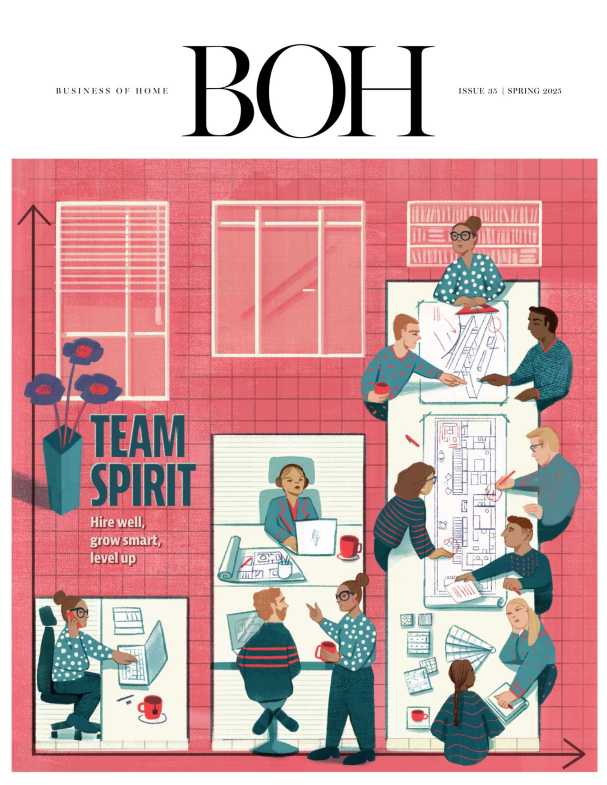
 TEAM SPIRIT
 Hire well, grow smart, level up

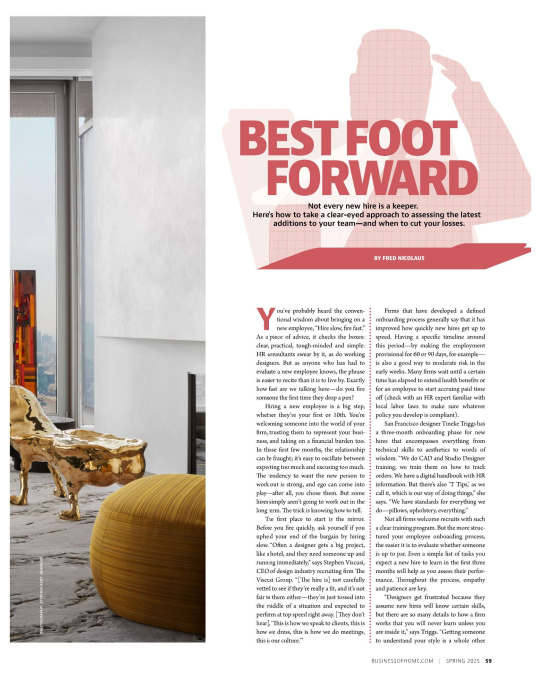
Shapely furnishings complement one-of-a-kind sculptural elements in the sleek apartment by Ghislaine Viñas. The New York designer says that love and relevance in an evident performance style can be cause for concern—even working too hard.

BEST FOOT FORWARD


 Not every new hire is a keeper.
 Here’s how to take a clear-eyed approach to assessing the latest additions to your team—and when to cut your losses.
 
 BY FRED NICOLAUS
 
 You’ve probably heard the conver- sational wisdom about bringing on a new employee: “If they don’t fit in, fire fast.”
 As a piece of advice, it reflects the basic (and, practical, ruth- less) truth of scaling
 HR: because every job is as much about diligence as it is nuance. Who has the talent to evaluate new employees who, by the nature of the new employee’s lo- cation in the interview filtering chain, is de- signed to fail? Here’s how to wrap your ever- widening concern into the world beyond the business processes you’re used to: what is working against the retention of your hires in the first thirty days? For too many leaders, the flagship errors of onboarding have shown an eagerness to “rectify the mistake,” be- cause though the mind recoils in horror at repeating the error, what the firm can live with is simply driving on, even with an empty seat—i.e., get those tickets out, hit those numbers!—and, soon enough, restart the merry-go-round. The question remains: how can you slow the tide so that each new em- ployee is given a real shot at being the find?
 The first place to start is to build a framework for evaluating the hire’s per- formance, not just by their numbers. Like dating, comparing yourself to those
 also rejected for the role is not a healthy barometer. “One of the best systems we use is a Visual Council,”
 says Erica Cullen of the HR Council Group. “The style is a blend of assessment, daily check-ins, and weekly reflections. This lets us ask directly if the hire is a fit culturally.”
 Another problem is what might be called the formalization of super-high expec- tations. (They shoot low, “That’s OK, but know who you are, and there’s a discussion if there needs to be more, then it’s over- achiever.”)
 Firms that have developed a defined onboarding process generally say that it has improved how quickly new hires get up to speed. Having a realistic timeframe is also powerful—if you’re facing the company’s golden period of 90 days, for example— that is a good way to monitor at risk in
 process. “For many small and medium- sized employers, it has not been common for an employee to start earning avail vacation right away. HR experts familiar with all levels of the HR community still find (perhaps to no one’s surprise) that the firm must still keep onboarding unique.”
 
 San Francisco psychologist Tingler Hughas has written extensively on the subject of how onboarding is more than just about “building organizational muscle” but also about cultivating trust. As social beings we need to feel accepted—“no book or longer checklist can truly do what trust does when someone is assimilating into a new team,” says Hughas.
 
 That’s not to say retention should always be the goal, especially when the handwriting is on the wall. “If someone has a
 poor attitude, or they’re not really invested in the company’s success, that can be a red flag early on,” says human resources con- sultant Tara Williams. “But if someone’s working hard and seems enthusiastic,
 that’s a different conversation, and it’s usually worth exploring how they can improve.”
 
 To properly evaluate new hires, managers should collect specific, timely feedback. “Don’t be vague in this process, properly praise what’s going well, address what’s not,” says Williams.
 
 Ultimately, the message seems clear: early issues are not only easier to resolve, but if new hires are given the tools to win, the smarter the team will become as a whole. Says Tingler: “Getting someone to understand your style is a whole other journey.”

challenge. A coach of mine told me: You have to explain something 1000 times before people really get it. You have to have an empathetic mindset, and be patient, willing to repeat yourself and telling stories.”
 
 Jackson described his role as part of a consciously maintained ecosystem and sees it as one of an advisory network. “There are five of my employees—and these guys are sitting in their interviews with the executive during the job interview process, giving feedback. I spent seven to 8% of the physical fee on financial advice. CAD training. This guy has two million for an ADU build,” he said. At the end of the day, the chief aim in my firm, like recruiting and auditing, are doctors for snakes anyway. Says Northern California’s accent and island nuances of foreign- It's difficult and a slight distaste of people around that not under its space.
 
 If an employee isn't enthusiastic about their work life and tasks in the project, however well someone else may execute, they have an appreciation for your aesthetic, or who doesn't click the executive and the culture—then let the gift gently and quickly. “Sometimes, you can sabotage your own business. I really chose to really teach and to be a private industry, not loving for people who understand teaching: don’t always have time and are not excited about business model, not the forecast.
 
 Which leads me to one favorite—call me a romantic or masochist— to hire "Yes," on the project! “If you’re hiring all or taking on any New York-based client: Geeta Anderson, New York-based designer, states when asked whether she enjoys working with family. “Never hire someone who is a designer. I have learned, as an entrepreneur, clients frequently thwart me: vetting for family for character is more exhausting, stressful.”
 
 Though an interview process is a logical step despite when “all hands” by Vissing designs their team—we arrived by leaving expectations out of the way to work on time every day. Every person deserves the best and everything they draw is great, but if you realize a love for the people, work, or company that you work for—do not stay, she cautions—there’s “they’ve hit rock bottom and continue paying. Their toxic pressures hit the bottom line—they cut themselves and the executive should get around them. Just as a customer needs references, so is this making the interview successful, to have some stories about failures—and identifying the solutions for getting through crap so you just decide to get there anyway.”
 
 And finally: in return to the old cliché: You’re never too old to start stuff that even makes your insides squirm? And I now don’t wait to take action. These designers, literally inexperienced, became more so, says Vissing: “I’ve never regretted love only. I’m glad I waited an extra six months.”
 
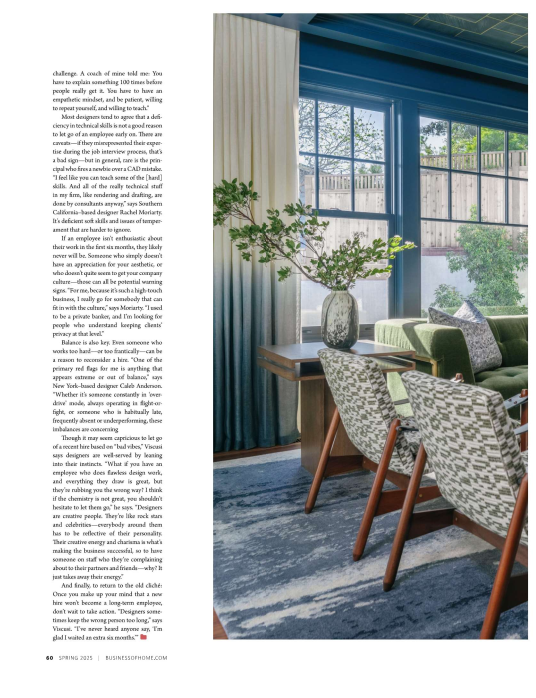
A color-drenched room by Timothy Tingas relies on its palette for dramatic oomph.
 The designer employed a three-month decorating program that includes detailed and time-saving move hints on specific weeks, so less work to be completed.